Brushy Creek · Williamson County
Dry Wells & Pop-Up Emitters in Brushy Creek, TX
Limestone-influenced soil can take water at first, then back up when it meets rock, while clay barely takes it at all. A dry well in Brushy Creek must be sited after checking how the soil drains and how deep rock sits. It also needs an overflow route. Pop-up emitters are the simpler fallback. Pop-up emitters need space downhill to work.
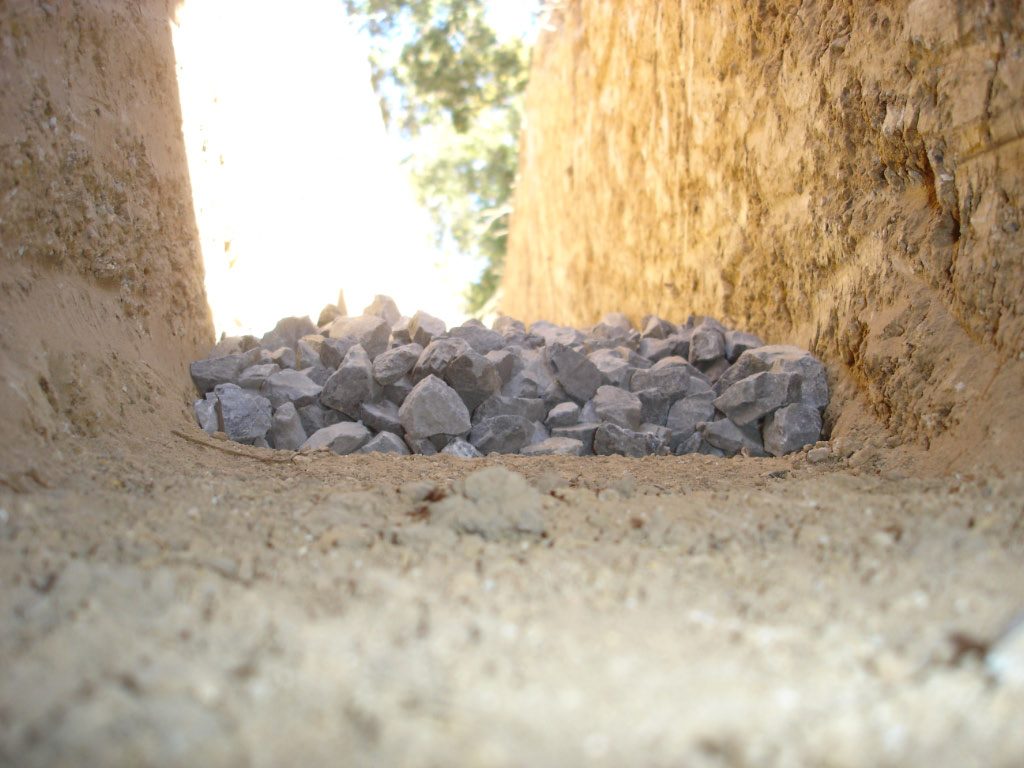
Dry Wells & Pop-Up Emitters for Brushy Creek homes
A dry well is an underground chamber, often a perforated tank or a gravel-filled pit, that takes in water from a pipe and lets it soak into the ground slowly. A pop-up emitter is the simpler cousin, a small cap at the end of a downspout or drain line that opens when water pushes through it. In Brushy Creek, both can solve the question of where to send roof or yard water on a small lot. They work well when the soil can take the water. That is the catch here, since the ground mixes limestone-based material and clay pockets, and absorption varies across a single yard from one corner to the other. Think of the dry well as a holding tank for a short time rather than a place that soaks up every drop. Its job is to hold a storm's water while the surrounding soil takes it in, which can take hours.
Clay is the weak spot. Where a clay pocket sits at the bottom of a dry well, water drains very slowly, and the pit can stay full for days. A simple test helps: dig a hole about a foot wide and two feet deep, fill it with water, and see how long it takes to drain. In rock-based spots the water may disappear quickly into cracks, which is good for capacity but means you should keep the well away from the foundation and from septic fields. If the test shows slow drainage, a pop-up emitter that sheds water over a lawn or a longer line to a better exit may work better than a pit. The same test also tells you about seasons. Clay pockets drain faster when dry and slower after weeks of rain, so a spot that passes in August can fail in April.
Placement rules matter. Keep a dry well well away from the foundation, often ten feet or more, and not at the low point where neighbors' runoff collects. Sizing should be based on the roof area it serves and the storm you want to handle. Brushy Creek lots in older sections can be tight, so utility lines and property setbacks limit options. Call 811 at least two working days before digging. Also confirm whether your HOA, the utility district or the city has rules on buried drainage structures. When in doubt, ask before you dig, since moving a buried tank later is costly and messy. A neighbor's finished work may also change what is safe for you, because a new drain or retaining wall next door can shift where water travels across the shared fence line.
What to know in Brushy Creek
Run a simple percolation check
Dig a test hole about two feet deep, soak it with water, then fill it again and time how fast it drops. If it drains in a few hours, the spot may suit a dry well. If water stands overnight, clay is controlling the site and an emitter or longer outlet is the better choice. Test more than one spot, since clay pockets are patchy.
Distance from the house
Water stored near a foundation can seep back toward it. Keep dry wells and emitters well away from the slab, and never next to a property line where the overflow could flow onto a neighbor. Ten feet is a common starting point, and more is better on a flat lot. Distance also gives the soil a chance to spread the water out before it reaches the house.
Overflow route for big storms
Every dry well fills eventually. A plan for overflow keeps a heavy storm from backing up into the downspout. That may be a surface swale, a second emitter or a pipe to a safe discharge. Without it, the system can overflow right beside the house, which is the problem it was supposed to fix in the first place.
Signs you may need dry wells & pop-up emitters
- Eroded soil or a washed-out patch where a pipe discharges
- An existing dry well or pit that stays full for days after rain
- Gurgling, backed-up drains or downspouts during storms
- A pop-up emitter that is buried, cracked, or stuck shut
How dry wells & pop-up emitters works
On many clay lots in Pflugerville, Hutto, Manor, and Taylor, a dry well is therefore a poor first choice and a pop-up emitter or a daylight outlet is better. That does not rule dry wells out. Some lots have sandy lenses, fractured limestone, or deeper permeable layers, particularly west of I-35 in Cedar Park and Leander where limestone is close to the surface. Larger wells, with more storage volume and greater side-wall area, can also help, and an overflow pipe to a secondary outlet gives a safety valve. The test result, not the town name, should decide, and a good installer will tell you if the answer is no. Honest advice sometimes means choosing a cheaper outlet than the one you asked about.
Where the water is released matters in law and in practice. Under Texas Water Code Section 11.086, you cannot divert or impound the natural flow of surface water in a way that damages another person's property by overflow. An emitter that sprays onto a shared fence line or a neighbor's patio could create that kind of claim, while a dry well that overflows toward the next lot could do the same. Locating the outlet well inside your own lot, aiming it along the natural slope, and leaving a clear overflow path across your own yard are the simplest ways to stay on the right side of that rule. If a dispute arises, a lawyer can advise you. Keeping written notes of where each outlet points is helpful if a neighbor ever raises a concern.
What to expect on a Brushy Creek visit
- 01
Decide whether the soil can take it
We dig a test hole where the dry well would go, fill it with water, and time how fast it drops. Slow results in clay tell us a dry well will not drain, and we recommend an emitter or daylight outlet instead. This one step prevents the most common and costly dry well failures. Results are shared with you.
- 02
Choose the outlet type and location
Based on the soil, slope, and lot size, we pick a dry well, a pop-up emitter, or a combination. We place the outlet well inside your property, away from the foundation, septic components, and neighbors, and we plan a clear overflow route across your own lawn for very heavy storms. We mark the plan on a sketch for you.
- 03
Call 811 and mark the work area
Texas law requires a call to 811 at least two business days before digging, excluding weekends and holidays. Public utilities mark their lines for free. We also paint the pipe route and well location, and we check for private irrigation lines and tree roots that could change the layout. We also confirm how deep the line sits.
- 04
Excavate and build the structure
For a dry well, we dig the pit, line it with filter fabric, and set a perforated chamber or fill it with washed stone. For an emitter, we trench the pipe on a steady downhill slope and set the fitting flush with the lawn. All connections are sealed and bedded on compacted material.
- 05
Connect inflow and add overflow protection
Pipes from downspouts or drains enter the top of the well or the start of the emitter line. A dry well gets an overflow pipe or a surface path in case it fills. We add cleanouts and, where useful, a small silt-catching basin ahead of the well to protect it. Everything is labeled on the sketch.
- 06
Test, backfill, and explain the upkeep
We run water through the whole system, check the speed of the outlet, and watch for leaks. Then we backfill in layers, restore the lawn, and show you how to check the emitter cap, clear debris, and tell if a well is draining or staying full after storms. You get a simple sketch of the finished layout.
Our approach in Brushy Creek
- We walk the property in Brushy Creek and trace where water comes from, where it collects and where it can legally go
- We explain what we find in plain language, with photos where they help
- Repairs and installs are planned around Williamson County permitting requirements
- You get written options before any repair work begins
- We call 811 to mark buried utilities before any digging
Soil and drainage conditions around Brushy Creek
Many of the neighborhoods here were built from the 1980s through the 2000s, with newer sections still being added. The area includes a Municipal Utility District named Brushy Creek MUD, which provides utility services to part of the community. Homes are mostly one- and two-story slab-on-grade houses on lots of moderate size. Many have backyards with a gentle slope toward a back fence, a greenbelt or a drainage channel. Homes that are 20 to 30 years old now have settled patios, aged downspout lines and landscaping beds higher than they should be. Newer homes sit on engineered fill that continues to compact. Both kinds of lot can develop low spots where water stays, especially where grading was done years ago and has since shifted. Many yards back onto greenbelts, and fences there sometimes block the flow that was designed into the neighborhood grade, so check before replacing one.
Dry Wells & Pop-Up Emitters questions from Brushy Creek homeowners
Will a dry well work in clay soil?
Not always. Clay absorbs water slowly, so a dry well in a clay pocket may stay full after a storm. Testing the soil first tells you more than guessing. In clay-heavy spots, a pop-up emitter, a longer drain line or a daylight outlet often works better than a buried pit that cannot empty between one storm and the next. It is worth testing the soil in the exact spot you have in mind.
What does a pop-up emitter do?
It sits flush with the lawn at the end of a buried pipe. When water flows in, the lid pops up and releases it onto the surface. When the flow stops, it closes. Emitters work on a slope or open lawn, but they need space for the water to spread and should not point at a neighbor's fence or a walkway.
Are there any limits on where I can put one?
Yes. Keep them away from foundations, septic systems, wells and property lines. Easements and city or HOA rules may also limit buried structures. Check your plat and ask the city or HOA before you dig. Texas Water Code section 11.086 also bars diverting water onto a neighbor's land to their harm, so the overflow path matters as well. A short call to the city or HOA can settle those questions before work starts.
What is a pop-up emitter?
It is a small fitting at the end of a buried drain pipe, set flush with the lawn. Water pressure pushes the cap open during rain and lets the water spill out across the grass. When the flow stops, the cap falls shut. It works best on a lot with enough slope and open space to spread the water. Ask where the cap sits relative to the mower.
How far from my house should a dry well be?
Commonly at least ten feet, and farther on clay soils or small lots when possible. The well should also stay away from septic systems, private water wells, utility lines, and property lines. Local rules and the soil on your lot may set different requirements, so check with your city or HOA, and follow any recommendation from your installer. Ask your installer to mark the distance on the plan.
Do I need to call 811 before installing a dry well?
Yes. Texas law requires notice to Texas811 at least two business days before digging, not counting weekends or holidays, and this applies to homeowners as well as contractors. Public utilities mark their lines for free. Private lines such as irrigation and lighting often are not marked, so tell the crew about them. Call early so your start date is not delayed.
More about dry wells & pop-up emitters → · All services in Brushy Creek →
Need dry wells & pop-up emitters in Brushy Creek?
Call or send a request. We will look at where the water goes, check the grade and give you a written estimate.