Elgin · Bastrop County
Dry Wells & Pop-Up Emitters in Elgin, TX
A dry well stores runoff underground and lets it seep out slowly, but clay seeps very slowly. In Elgin's dense soil, a dry well often needs extra size, a gravel bed and an overflow path, and some sites will not suit one at all. We test how fast the ground drains before recommending it. Pop-up emitters give water a safe surface exit instead.
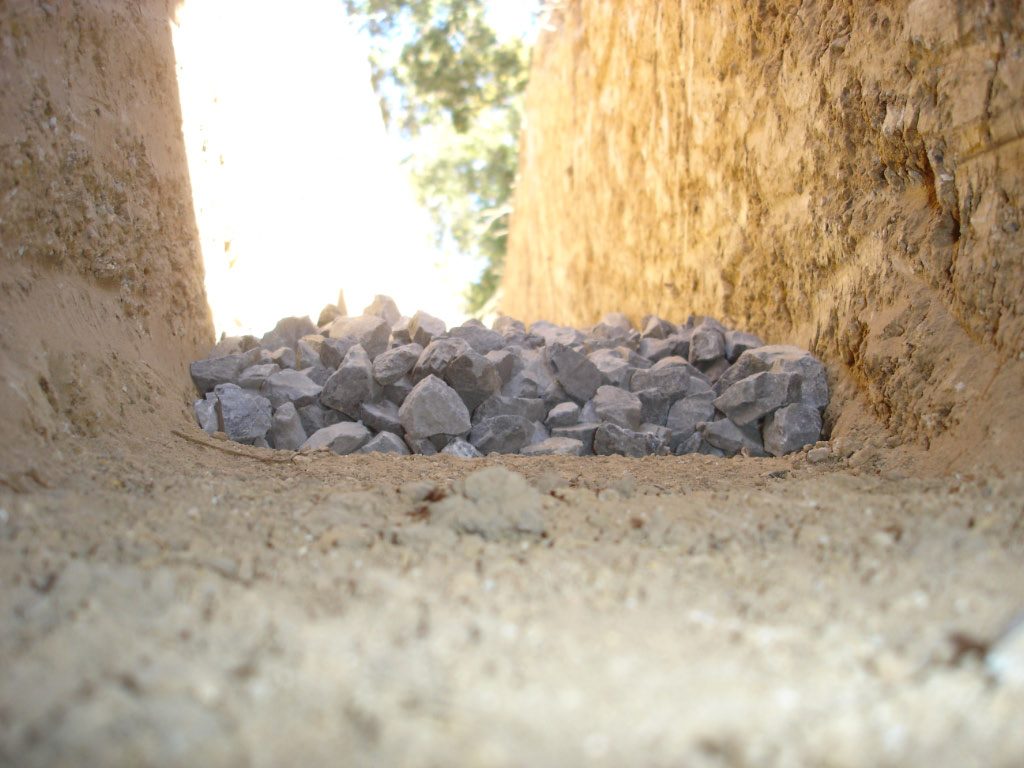
Dry Wells & Pop-Up Emitters for Elgin homes
A dry well is a buried chamber filled with gravel or a plastic crate system. It holds roof or yard runoff and lets it soak into the ground slowly. That works well in sandy or loamy soil. In Elgin's clay-heavy ground, it needs honest scrutiny. Clay absorbs water slowly, and once it is wet, it may barely absorb at all. A dry well here will fill and then drain over days instead of hours. One common mistake is placing a dry well too close to the house. Water released near a slab saturates the very clay that holds the foundation. A typical rule is to keep a well at least 10 feet from the foundation, and farther is better, with a clear path for overflow if the well is ever full.
That does not rule it out. It means the well must be sized for storage and not just for soaking. A larger gravel volume gives the water a place to wait while it seeps out. A simple soak test, filling a hole with water and timing how fast it drops, helps decide whether a dry well fits your lot. If the hole barely drains, a pop-up emitter or a surface outlet will likely work better than a well. Plastic storage crates have largely replaced old-style gravel pits and barrels. They hold more water per cubic foot and let you size the well to a real storm. In slow clay, that extra volume matters because the water may need a day or two to leave. A fabric wrap keeps silt out, and an inspection port lets you check the water level.
Pop-up emitters are the lower-cost cousin. A buried pipe carries water out to a spot in the yard, and a small cap lifts open under pressure to release it onto the lawn. On Elgin's larger lots, there is often room to place an emitter well away from the house and neighbors, on ground that slopes away. Keep dry wells and emitters far from septic fields and your well water source, and check with the City of Elgin, Bastrop County or your HOA on rules. Call 811 before you dig. Emitters are best placed on a gentle downhill spot where grass can take the water. Lawn grass tolerates it, but bare clay erodes. A short splash pad or a bed of river rock at the outlet spreads the flow. On acreage, you can even direct emitter water to a tree line or a pasture edge.
What to know in Elgin
Soak test before you commit
Dig a hole about 12 inches across and 24 inches deep, fill it with water, and see how much it drops in an hour. In Blackland clay the answer is often very little. A slow result points to a larger well, a surface emitter or a different design. Late-summer cracks can hide how poorly the same soil drains after a long wet stretch, so test after rain if you can.
Seasonal swelling
Dry clay cracks and takes water quickly at first. Wet clay seals itself. A dry well that works in August can fail in a wet March. Design for the wet season, when the ground is saturated and the well must still hold a full storm. Keep the well at least 10 feet from the slab, and farther if the lot slopes toward the house.
Distance from septic and water wells
Many Elgin-area properties rely on septic systems or private water wells. A dry well adds water to the ground, which can overload a drain field or carry surface contamination toward a well. Keep generous separation and check local guidance. Septic and water-well setbacks are set by state and local rules, so ask the county before siting anything.
Signs you may need dry wells & pop-up emitters
- Runoff streaming toward a neighbor's fence or yard
- A downspout or drain pipe with no clear place to send its water
- Water pooling at the end of a pipe or splash block
- Eroded soil or a washed-out patch where a pipe discharges
How dry wells & pop-up emitters works
A dry well is a buried chamber that holds stormwater and lets it soak into the surrounding ground. Most residential versions are one of two types: a pit filled with washed gravel and wrapped in filter fabric, or a perforated plastic or concrete tank with open sides, set in a gravel bed. Pipe from a downspout, catch basin, or French drain feeds into the top. During a storm the well fills with water faster than the soil can absorb it, then empties over hours or days as the water seeps outward. It does not pump anything or use power. It only buys time, by storing a burst of runoff and letting the ground take it in at its own pace. Because the well is hidden, it is easy to forget, so note its location on a simple sketch of your yard.
A pop-up emitter works very differently. It is a small fitting, often with a hinged or spring-loaded cap, sitting flush with the lawn at the end of a buried pipe. When water flows through the pipe, pressure pushes the cap open and the water spills onto the surface. When the flow stops, the cap drops back and closes, which keeps out mowers, insects, and small animals. An emitter does not store anything, and it does not rely on soil absorption. Its job is to release water over a wide patch of lawn, which spreads the flow out and reduces erosion compared with a bare pipe end. It needs a slope that carries the water away from the house. Emitters are also easy to inspect, since you can see them and lift the cap to check for debris.
What to expect on a Elgin visit
- 01
Decide whether the soil can take it
We dig a test hole where the dry well would go, fill it with water, and time how fast it drops. Slow results in clay tell us a dry well will not drain, and we recommend an emitter or daylight outlet instead. This one step prevents the most common and costly dry well failures. Results are shared with you.
- 02
Choose the outlet type and location
Based on the soil, slope, and lot size, we pick a dry well, a pop-up emitter, or a combination. We place the outlet well inside your property, away from the foundation, septic components, and neighbors, and we plan a clear overflow route across your own lawn for very heavy storms. We mark the plan on a sketch for you.
- 03
Call 811 and mark the work area
Texas law requires a call to 811 at least two business days before digging, excluding weekends and holidays. Public utilities mark their lines for free. We also paint the pipe route and well location, and we check for private irrigation lines and tree roots that could change the layout. We also confirm how deep the line sits.
- 04
Excavate and build the structure
For a dry well, we dig the pit, line it with filter fabric, and set a perforated chamber or fill it with washed stone. For an emitter, we trench the pipe on a steady downhill slope and set the fitting flush with the lawn. All connections are sealed and bedded on compacted material.
- 05
Connect inflow and add overflow protection
Pipes from downspouts or drains enter the top of the well or the start of the emitter line. A dry well gets an overflow pipe or a surface path in case it fills. We add cleanouts and, where useful, a small silt-catching basin ahead of the well to protect it. Everything is labeled on the sketch.
- 06
Test, backfill, and explain the upkeep
We run water through the whole system, check the speed of the outlet, and watch for leaks. Then we backfill in layers, restore the lawn, and show you how to check the emitter cap, clear debris, and tell if a well is draining or staying full after storms. You get a simple sketch of the finished layout.
Our approach in Elgin
- We walk the property in Elgin and trace where water comes from, where it collects and where it can legally go
- We explain what we find in plain language, with photos where they help
- Repairs and installs are planned around Bastrop County permitting requirements
- You get written options before any repair work begins
- We call 811 to mark buried utilities before any digging
Soil and drainage conditions around Elgin
Expect three problems again and again in Elgin. First, soggy yards where the clay refuses to absorb water, which is where French drains, surface swales and dry wells do the most good. Second, downspouts that dump right at the foundation, which feed the same clay that swells and shrinks under the slab. Third, concrete that sinks or heaves, because clay moves with moisture and fill under new slabs compacts unevenly. Foam leveling lifts patios, walks and driveways without tearing them out, and crack and joint sealing keeps surface water from washing under the edges. We do not repair structural foundations. If doors stick, bricks crack or you see stair-step cracks in the walls, have a structural engineer or foundation repair company evaluate the house. Fixing the drainage around it is often part of keeping the repair stable. Dry summers make it worse, because shrunken clay opens cracks that gulp the first rain, then swells shut and sends the rest across the surface. Annual rainfall is roughly in the mid-30 inches.
Dry Wells & Pop-Up Emitters questions from Elgin homeowners
Will a dry well work in Elgin clay?
It can, if it is sized for storage and the water is not expected to soak in quickly. A percolation test tells you more than a guess. When the soil drains very slowly, a pop-up emitter that spreads water across a lawn slope is usually a better fit. Ask for the soak test result in writing so the well is sized to your soil, not to a generic chart.
What is a pop-up emitter?
It is a small cap on the end of a buried drain pipe. When water pushes through, the cap rises and the water flows out onto the yard. When the flow stops, the cap closes. It keeps debris and small animals out and sits nearly flush with the grass. A well with no overflow path can push water back toward the house, so plan where extra water goes.
How big should a dry well be?
Size depends on the roof area or drainage area feeding it and on how quickly the soil drains. A well for one downspout is much smaller than one for a whole roof. We size by measuring the area, estimating storm volume and checking the soak rate on site. Check the cap a couple of times a year, since mowers and grass clippings can jam it shut.
Will a dry well or emitter protect my foundation?
They help by moving roof and drain water away from the slab, which keeps the soil around the foundation more evenly moist on expansive clay. They do not repair existing damage. If you see widening cracks, doors that stick, or gaps around trim, a structural engineer or foundation repair company should evaluate the house. Drainage and structural repair are separate jobs.
Do I need HOA or city approval for a dry well or emitter?
It depends on where you live. Some cities regulate where stormwater may be discharged, and many HOAs review visible changes to the yard. Work in a drainage easement may need approval too. Rules differ, so check with your city or HOA before work begins, and keep approvals in writing. An email to your HOA is a good first step. Rules differ from city to city.
Does a dry well work in clay soil?
Usually not well. Heavy clay absorbs water very slowly, so a dry well can fill and stay full for days. Some lots have sandier layers or fractured limestone that accept water better. A percolation test in your own yard is the way to find out, and if the soil fails the test, a pop-up emitter or daylight outlet is usually the better choice. Ask for the test result in writing.
More about dry wells & pop-up emitters → · All services in Elgin →
Need dry wells & pop-up emitters in Elgin?
Call or send a request. We will look at where the water goes, check the grade and give you a written estimate.