Elgin · Bastrop County
French Drain Installation in Elgin, TX
A French drain gives water in Elgin's heavy clay a place to go when the soil itself will not take it. We dig a sloped trench, line it with fabric, lay perforated pipe in washed gravel and send the water to a daylight outlet or a street ditch. On flat lots the trench slope is the hard part, so we survey fall carefully and sometimes pair the drain with a catch basin or pop-up emitter. Call 811 first.
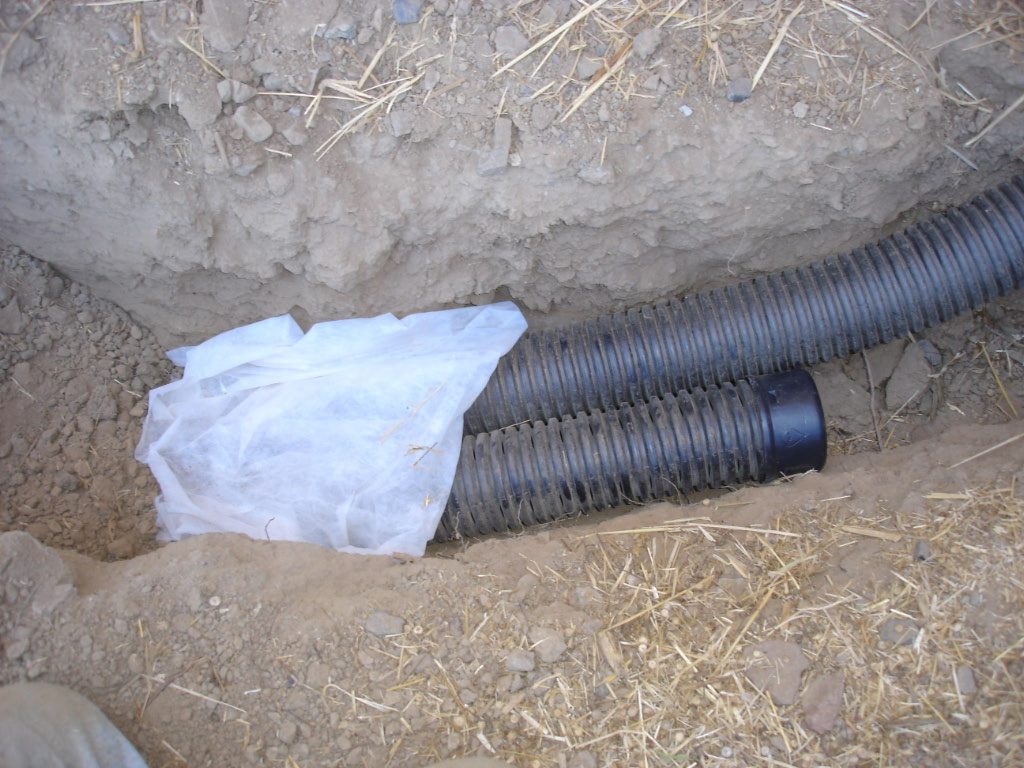
French Drain Installation for Elgin homes
Elgin lots are often bigger than what you find in Pflugerville or Round Rock, and that changes how a French drain is planned. A run along the back of a half-acre property can easily top 100 feet. At that length, the pipe slope, the gravel volume and the outlet matter more than the trench itself. A drain that collects water but has nowhere legal and lower to send it just moves the puddle. Another quirk of larger lots is that the wet area is often far from the house. A pooling spot near a back fence or a barn may sit 80 feet from any downspout, so a short drain tied into existing pipe is not an option and the run has to be planned as its own system.
Most of Elgin sits east of I-35 in the Blackland Prairie belt, where heavy clay holds water and releases it slowly. Clay does not drink a storm. Water rides along the surface or sits just under the sod until a trench gives it somewhere to go. A French drain here works best as an interceptor, set uphill of the low spot, wrapped in fabric so fine clay particles do not clog the gravel. Soil can change quickly over short distances, so check your lot on the USDA Web Soil Survey before assuming what is under your grass. Gravel size is one more detail worth settling. Washed three-quarter inch stone leaves open space for water, while crusher fines pack tight and block it. A perforated pipe set with holes facing down, wrapped in non-woven fabric, keeps clay silt out for years and lets the trench act as a water highway instead of a sponge.
Outlets are the real design question in Elgin. Some lots can daylight to a roadside ditch along a county road or a street, and some cannot without permission. Texas Water Code section 11.086 says you cannot divert surface water in a way that floods a neighbor, so the discharge point should land on your own ground or a proper drainage path. If you are inside city limits, check with the City of Elgin first. Outside the city, ask Bastrop County about ditches and culverts. Call 811 at least two business days before any trench is dug. Expect some trade-offs on a long run. Trenching across a well-kept pasture or lawn leaves a visible scar for a season, and mature trees may force the line to curve around roots. A good plan marks the route with paint first so you can approve the path, the depth and the exit before any ground is opened.
What to know in Elgin
Long runs need a firm slope plan
On a flat Elgin acreage lot, a 150-foot drain needs enough fall to keep water moving, commonly about one inch per 8 to 10 feet is a rule of thumb. That can push the far end deep. Planning the grade first, with a level or laser, decides whether the drain stays shallow or needs a sump and pump. Walk the planned line with a hose or string, and ask the crew to show the finish elevation at both ends.
Ditch and culvert ownership
Roadside ditches and culverts in and around Elgin may belong to the city, the county or TxDOT depending on the road. Do not tie a drain into one without checking who maintains it. A quick call to the City of Elgin or Bastrop County can save you from a forced removal later. A written note of who owns the ditch gives you something to point to if a neighbor asks.
Septic fields nearby
Many properties outside the city center use septic systems. A French drain should stay well clear of the tank and drain field, and it should never send water toward them. Wet soil over a drain field can cause failures. Locate your system before any trenching starts. Mark the tank, field lines and any private water well on a sketch and hand it to the crew.
Signs you may need french drain installation
- A neighbor's runoff or a slope that sends water toward your house
- Standing water in the yard that is still there two or three days after rain
- A soft, spongy strip of lawn along the foundation or fence line
- Moss, algae, or mosquito activity in a low part of the yard
How french drain installation works
A French drain is simpler than it sounds. Crews dig a narrow trench, line it with filter fabric, lay a perforated pipe on a bed of washed gravel, and cover the pipe with more gravel before closing the fabric over the top. Water that moves through the soil reaches the gravel, drops into the pipe, and rolls downhill to a place where it can leave your property safely. The name is usually traced to Henry Flagg French, a Massachusetts farm writer whose 1859 book Farm Drainage described the method, and not to France. The design has barely changed since, because the physics is so basic: water follows the easiest path, and gravel and pipe are a much easier path than packed soil. The result is a quiet, hidden system that works every time it rains without pumps or power.
Around Pflugerville, the reason a French drain helps has a lot to do with the ground itself. The Blackland Prairie soils east of I-35 are heavy clay that absorbs water slowly. A rain that a sandy lot would swallow in an hour can sit in a clay yard for days, because the tiny clay particles hold water tightly and leave little room for it to drain through. A French drain gives that trapped water a shortcut. It does not make clay drain like sand, but it creates a continuous underground channel that intercepts water before it pools against a slab, a fence line, or a low corner of your lawn. After a wet spring, that slow absorption is exactly why lawns near Gilleland Creek and Wilbarger Creek can stay muddy long after the sky clears.
What to expect on a Elgin visit
- 01
Walk the property and read the water
We look at where water pools, where it enters the yard, and how it behaves a day after rain. We check lot slope, gutter outlets, neighboring grades, and fence lines. Photos of the yard during or right after a storm help a lot. This visit sets the drain's location and shows whether a French drain is the right tool at all.
- 02
Call 811 and mark the layout
Texas law requires a call to 811 at least two business days before digging, weekends and holidays excluded. Utilities mark their public lines for free. We also paint the planned trench path, and we flag private lines such as irrigation, which public locators usually do not mark, so the trench avoids them.
- 03
Set the slope and dig the trench
The trench is cut to a consistent grade, usually about one percent or steeper, and to a depth that suits the problem. We check the bottom with a laser or level before anything goes in. Sod and topsoil are set aside when possible so the lawn can be put back with less visible scarring.
- 04
Line, pipe, and gravel
Filter fabric lines the trench so clay and silt cannot clog the gravel. Washed stone goes down first, then perforated pipe with holes facing down in most designs, then more stone. The fabric folds over the top. Clean, rounded or angular washed stone is used rather than soil-laden fill that would plug the voids.
- 05
Build the outlet and connections
The solid pipe leading away from the perforated section runs to the chosen exit, such as a daylight point, a pop-up emitter, a catch basin, or a dry well where soil allows. Cleanouts or inspection points are added at turns where practical, so the line can be flushed later if it ever slows.
- 06
Test, backfill, and restore
We run water through the system to confirm flow and to watch the outlet. After a pass, the trench is topped with soil or a layer of decorative stone, and the area is raked and graded. We review the finished layout with you, including where the cleanouts are and what to watch after the first heavy rain.
Our approach in Elgin
- We walk the property in Elgin and trace where water comes from, where it collects and where it can legally go
- We explain what we find in plain language, with photos where they help
- Repairs and installs are planned around Bastrop County permitting requirements
- You get written options before any repair work begins
- We call 811 to mark buried utilities before any digging
Soil and drainage conditions around Elgin
Expect three problems again and again in Elgin. First, soggy yards where the clay refuses to absorb water, which is where French drains, surface swales and dry wells do the most good. Second, downspouts that dump right at the foundation, which feed the same clay that swells and shrinks under the slab. Third, concrete that sinks or heaves, because clay moves with moisture and fill under new slabs compacts unevenly. Foam leveling lifts patios, walks and driveways without tearing them out, and crack and joint sealing keeps surface water from washing under the edges. We do not repair structural foundations. If doors stick, bricks crack or you see stair-step cracks in the walls, have a structural engineer or foundation repair company evaluate the house. Fixing the drainage around it is often part of keeping the repair stable. Dry summers make it worse, because shrunken clay opens cracks that gulp the first rain, then swells shut and sends the rest across the surface. Annual rainfall is roughly in the mid-30 inches.
French Drain Installation questions from Elgin homeowners
Can I drain my Elgin yard into the street or ditch?
Sometimes, but not automatically. Many roadside ditches are designed to carry stormwater, yet the owner of the ditch may still limit new connections. Inside city limits, ask the City of Elgin. Outside, ask Bastrop County. Either way, you cannot send water onto a neighbor's land in a way that damages it under Texas Water Code section 11.086. Rule of thumb: if you cannot point to where the last gallon exits, the design is not finished.
How deep should a French drain be in Blackland clay?
Most residential drains run 12 to 24 inches deep, and deeper only when the slope or outlet requires it. In clay that cracks when dry, a shallow drain wrapped in fabric works well because it catches water right where it collects. Deeper trenches cost more and are not always better. Depth is set by where the outlet is. On flat ground, a shallower trench with a longer outlet run often beats a deep trench that needs a pump.
Will a French drain fix a wet spot near my slab?
It can help by pulling water away before it reaches the foundation edge. It will not fix a structural problem. If you see wide cracks, sticking doors or sloping floors, have a structural engineer or foundation repair company evaluate the house. Drainage then supports their work by keeping soil moisture steady. Grading the last few feet of lawn toward the trench lets surface water enter the drain instead of skipping over it.
Do I need a permit or HOA approval?
It depends on your city and neighborhood. Some HOAs require approval for changes to grading or visible hardscape, and work in a drainage easement may need city approval. Rules differ from Pflugerville to Round Rock to Georgetown, so check with your city or HOA before work starts instead of assuming it is allowed. Ask for any approval in writing. Cities such as Pflugerville and Round Rock handle this differently.
How long does a French drain last?
A well-built system can last decades, because gravel and pipe do not wear out like mechanical parts. Its lifespan depends on how well the fabric keeps fines out, how roots are managed, and whether the outlet stays clear. Walk the outlet once or twice a year and clear leaves and debris so water can leave freely. Pipe never wears out like a pump.
Will a French drain fix standing water in my yard?
Often yes, when the water comes from soil that is saturated and has nowhere to go. A French drain collects that underground water and moves it to an exit. It works less well when the problem is surface runoff, a flat yard with no outlet, or a leaking pipe. A site visit sorts out which problem you have before any digging starts.
More about french drain installation → · All services in Elgin →
Need french drain installation in Elgin?
Call or send a request. We will look at where the water goes, check the grade and give you a written estimate.