Taylor · Williamson County
Dry Wells & Pop-Up Emitters in Taylor, TX
Dry wells store runoff and let it seep out, but Blackland clay is slow to accept water, so Taylor pits are sized larger and include an overflow path. Pop-up emitters are simpler where there is open ground downhill. We make sure discharge cannot reach a neighbor's yard or a crawl space. We test how fast the soil takes water before sizing the pit.
Dry Wells & Pop-Up Emitters for Taylor homes
A dry well stores runoff underground so it can soak out slowly. It needs soil that accepts water, and that is the catch in Taylor. Blackland clay is among the slowest soils for water to move through, and once it is wet it can seal up almost completely. In most Taylor yards a classic dry well would fill during a storm and stay full for days. That does not mean dry wells never work here, but it means they should only be built after a soak test shows the ground can take the water. The soak test is simple and cheap. Dig a hole a foot across and a foot deep, fill it twice to wet the soil, then fill it a third time and time how long it takes to empty. Under about an inch per hour is slow, and Taylor clay often tests that way.
More often, a pop-up emitter is the better fit. It connects to a buried pipe, and when water flows the cap rises and releases it onto the lawn. The water spreads over the surface and drains off the lot on the natural slope. On Taylor's flat ground, the key is picking an emitter location that is lower than the pipe inlet and has a surface path to leave the property. If there is no such path, a pumped basin may be needed. Pop-up emitters are only a few inches across, so they are easy to hide in a lawn. Put them in an open area, not beside a fence or a tree trunk. Sloped ground below the emitter helps water spread thin and leave, rather than collecting around the cap.
A rain garden is another option on larger lots. It is a shallow, planted basin that holds water for a day or so, and deep-rooted native plants help open the clay over time. Texas Blackland native grasses and forbs do this well. All of these approaches need distance from the foundation and from neighbors. Before digging, call 811, check HOA rules, and ask the City of Taylor if any drainage easement crosses your yard. Rain barrels and cisterns can also reduce what reaches the ground. Water stored in a barrel can be used on plants between storms, which cuts the volume in the yard. A barrel does not replace drainage in a big storm, but it takes a bite out of the flow.
What to know in Taylor
Clay seals when wet
Blackland clay swells shut when saturated, so a dry well that drains well in dry weather may stop draining in a wet spring. Test during or after a wet period if you can, because a dry-weather test can overstate how fast the ground takes water. Repeat the soak test in a wet season if the first one was in a dry month.
Emitters need a downhill path
On flat Taylor lots it is easy to put an emitter where water simply ponds. Walk the area and confirm that water leaving the emitter can reach the street, a swale or a ditch over the surface. If it cannot, the emitter will keep the lawn soggy. Fence and shed posts rot faster in constantly wet soil, so keep emitters away from them.
Native plants help soak water
Deep-rooted Blackland prairie plants, such as switchgrass or little bluestem, open channels in clay over time. A rain garden planted with them takes in more water each year. It is slower than a pit but it adds beauty and needs little maintenance once established. Avoid planting trees near an emitter, since roots can enter and clog the line.
Signs you may need dry wells & pop-up emitters
- A pop-up emitter that is buried, cracked, or stuck shut
- Runoff streaming toward a neighbor's fence or yard
- A downspout or drain pipe with no clear place to send its water
- Water pooling at the end of a pipe or splash block
How dry wells & pop-up emitters works
Placement, depth, and safety round out the planning. A dry well should sit well away from the foundation, commonly at least ten feet and often more, and away from septic fields, wells, and property lines. Depth is limited by what lies below: utilities, rock, and groundwater. Texas law requires a call to Texas811 at least two business days before digging, and that applies to homeowners. Rules for dry wells and for discharge to the street differ by city, and some HOAs review visible emitters, so check with your city or HOA before you commit to a design. A short written plan keeps everyone aligned. Keep a copy of any approval and a sketch of the layout with your home records, so a future owner knows what was built and where.
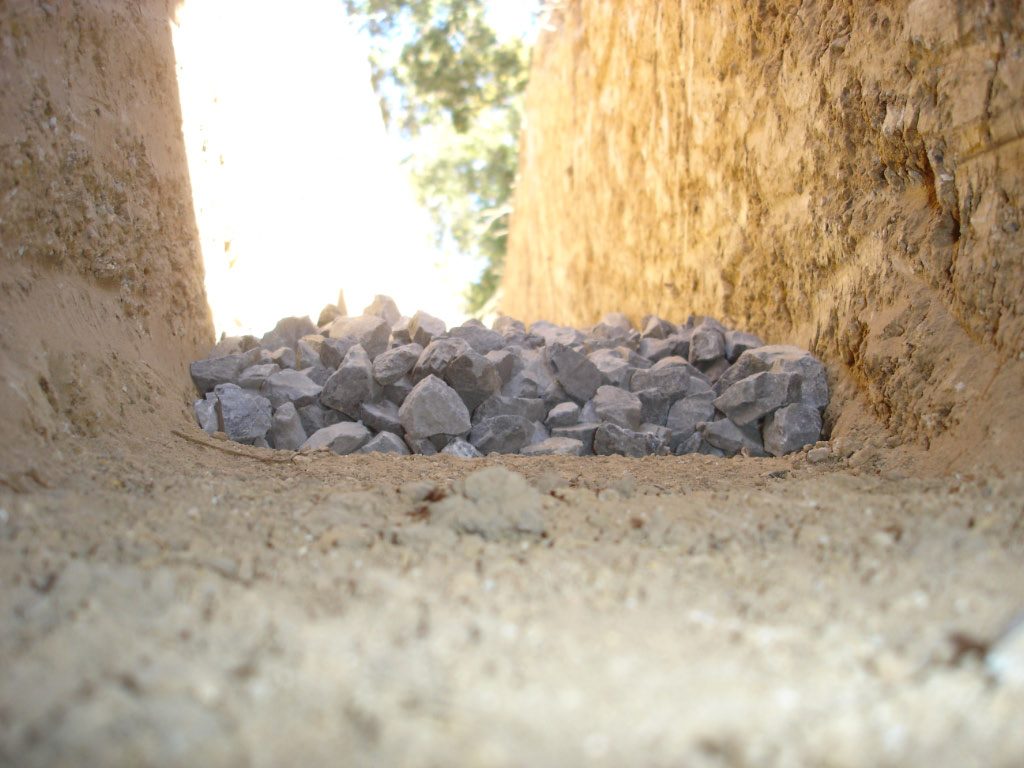
A dry well is a buried chamber that holds stormwater and lets it soak into the surrounding ground. Most residential versions are one of two types: a pit filled with washed gravel and wrapped in filter fabric, or a perforated plastic or concrete tank with open sides, set in a gravel bed. Pipe from a downspout, catch basin, or French drain feeds into the top. During a storm the well fills with water faster than the soil can absorb it, then empties over hours or days as the water seeps outward. It does not pump anything or use power. It only buys time, by storing a burst of runoff and letting the ground take it in at its own pace. Because the well is hidden, it is easy to forget, so note its location on a simple sketch of your yard.
What to expect on a Taylor visit
- 01
Decide whether the soil can take it
We dig a test hole where the dry well would go, fill it with water, and time how fast it drops. Slow results in clay tell us a dry well will not drain, and we recommend an emitter or daylight outlet instead. This one step prevents the most common and costly dry well failures. Results are shared with you.
- 02
Choose the outlet type and location
Based on the soil, slope, and lot size, we pick a dry well, a pop-up emitter, or a combination. We place the outlet well inside your property, away from the foundation, septic components, and neighbors, and we plan a clear overflow route across your own lawn for very heavy storms. We mark the plan on a sketch for you.
- 03
Call 811 and mark the work area
Texas law requires a call to 811 at least two business days before digging, excluding weekends and holidays. Public utilities mark their lines for free. We also paint the pipe route and well location, and we check for private irrigation lines and tree roots that could change the layout. We also confirm how deep the line sits.
- 04
Excavate and build the structure
For a dry well, we dig the pit, line it with filter fabric, and set a perforated chamber or fill it with washed stone. For an emitter, we trench the pipe on a steady downhill slope and set the fitting flush with the lawn. All connections are sealed and bedded on compacted material.
- 05
Connect inflow and add overflow protection
Pipes from downspouts or drains enter the top of the well or the start of the emitter line. A dry well gets an overflow pipe or a surface path in case it fills. We add cleanouts and, where useful, a small silt-catching basin ahead of the well to protect it. Everything is labeled on the sketch.
- 06
Test, backfill, and explain the upkeep
We run water through the whole system, check the speed of the outlet, and watch for leaks. Then we backfill in layers, restore the lawn, and show you how to check the emitter cap, clear debris, and tell if a well is draining or staying full after storms. You get a simple sketch of the finished layout.
Our approach in Taylor
- We walk the property in Taylor and trace where water comes from, where it collects and where it can legally go
- We explain what we find in plain language, with photos where they help
- Repairs and installs are planned around Williamson County permitting requirements
- You get written options before any repair work begins
- We call 811 to mark buried utilities before any digging
Soil and drainage conditions around Taylor
Taylor was built for the railroad. Like Hutto and Thrall, it grew after the railroad arrived around 1875, when land that had been mostly dormant turned into a shipping point for cotton and other crops. That history shows in the houses. Historic homes near the old downtown often have pier-and-beam foundations, deep porches, original sidewalks and little modern drainage. Mid-century neighborhoods have slab homes with older concrete and gutters that may be cracked or missing. Newer subdivisions on the edge of town have small lots and builder grading that is still settling. Each type needs a different approach. For an older house, we look first at how gutters, grade and the crawl space area handle water. For a newer slab home, we look at swales, downspouts and soil compaction. For a historic home, ask a neighbor with a similar house what drainage work has been done, because the earliest owners may have left no records.
Dry Wells & Pop-Up Emitters questions from Taylor homeowners
Do dry wells work in Taylor?
Rarely as a stand-alone fix. The clay absorbs water slowly, so a dry well is likely to fill and stay full after big storms. A soak test tells you for sure. Most Taylor lots do better with solid pipe to a pop-up emitter, a swale or a street outlet instead of a pit. Some emitters have a screen or cartridge that needs rinsing a couple of times a year.
What is a pop-up emitter?
It is a drain fitting with a spring-loaded cap that sits flush with the lawn. Water from a buried pipe pushes it open and flows out. When the water stops, the cap closes to keep out debris and animals. It is easy to mow over and fits well on flat residential lots. A sump pump is the fallback if no gravity outlet exists, though it needs electricity and maintenance.
Can I just dig a hole and fill it with gravel?
You can, but in Taylor clay it often fails. A gravel pit surrounded by clay can fill and sit as a small underground pond. It may also pull water toward the house if placed too close. Test the soil first, keep it far from the slab, and consider an emitter instead. Gravel only helps when the soil around it can take in water, which is not common in Blackland clay.
How do I know if my dry well is working?
Watch it after a storm. A working dry well should empty within a day or two. If it still holds water after several days, the soil may be too slow, silt may have clogged the stone or fabric, or groundwater may be high. A pro can inspect the inlet, flush the pipes, and advise on repair or replacement. Do this check twice a year.
Will a dry well or emitter protect my foundation?
They help by moving roof and drain water away from the slab, which keeps the soil around the foundation more evenly moist on expansive clay. They do not repair existing damage. If you see widening cracks, doors that stick, or gaps around trim, a structural engineer or foundation repair company should evaluate the house. Drainage and structural repair are separate jobs.
Do I need HOA or city approval for a dry well or emitter?
It depends on where you live. Some cities regulate where stormwater may be discharged, and many HOAs review visible changes to the yard. Work in a drainage easement may need approval too. Rules differ, so check with your city or HOA before work begins, and keep approvals in writing. An email to your HOA is a good first step. Rules differ from city to city.
More about dry wells & pop-up emitters → · All services in Taylor →
Need dry wells & pop-up emitters in Taylor?
Call or send a request. We will look at where the water goes, check the grade and give you a written estimate.