Cedar Park · Williamson County
Catch Basins & Channel Drains in Cedar Park, TX
Water moving down a Cedar Park slope often meets a patio, driveway or retaining wall all at once. Catch basins and channel drains intercept it and pass it through pipe. They are especially useful at the base of a sloped driveway, where sheets of runoff can reach the garage door. Rock below can limit depth, so we set inlets to suit.
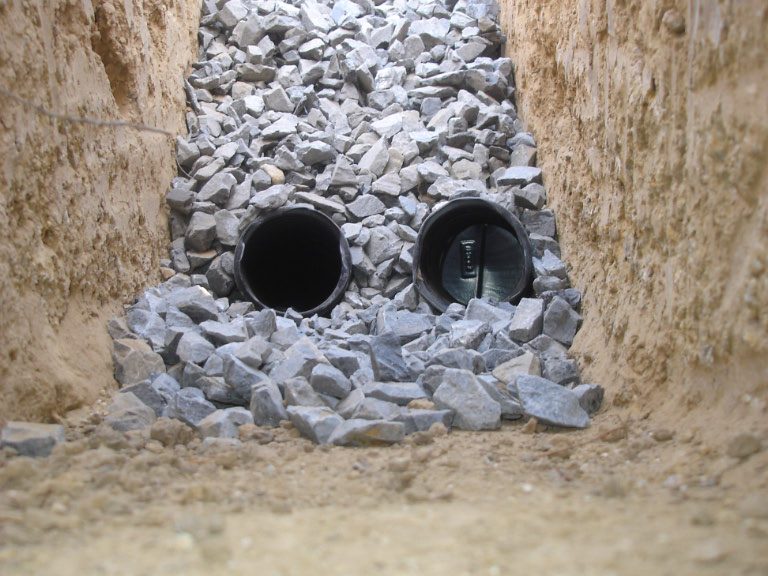
Catch Basins & Channel Drains for Cedar Park homes
Catch basins and channel drains are surface collectors. A basin is a boxed inlet with a grate at a low point. A channel drain is a long, narrow slot with a grate that runs across a driveway, a patio edge or a garage door. In Cedar Park they make sense wherever hillside runoff concentrates. A driveway that slopes down toward the garage is the classic case. Water gathers speed on the way down the street side, hits the flat apron and slides under the door. A channel drain set across the bottom of the drive catches it before it can cross the threshold. Without the drain, the water often pools against the door seal, wets the garage floor and soaks the drywall at the base of the wall.
The collected water needs somewhere to go, and that is where the geology comes in. Behind the grate, a pipe must carry water to a street, a swale or a rock-lined outlet. In Cedar Park, that pipe may have to be cut through limestone, or route around a shelf of rock, so the depth of the basin and the fall of the pipe must be planned together. A basin set too deep for the outlet will sit full of water. Clay pockets near the outlet can hold water if it spreads onto flat ground, so a hard, defined exit is usually better than a soft one that goes soggy. Ask for a drawing of the pipe route and depth, so you know what is underground before any landscaping or fence work begins later.
Cedar Park uses the Austin Drainage Criteria Manual for drainage design, so a system that handles a lot of water, or connects to the public storm system, may need city review. Ask before you tie into a curb inlet or a public pipe. HOAs may also want a say if the drain is visible from the street. Keep the sump and grate clean, since pine and oak litter, mulch and fine silt fill basins quickly on bare hillsides. If your problem is water coming from a neighbor above you, a drain can catch it, but the Texas Water Code section 11.086 rules about diverting surface water still apply. Cleaning is quick with a small shovel and a bucket, and a basin that is emptied before storm season works far better than one left full.
What to know in Cedar Park
Driveways that slope to the garage
Many Cedar Park homes sit above or below the street, so the driveway tilts to or away from the garage. If it tilts toward, a channel drain at the base is the first line of defense. It must sit at the true low point and the pavement must slope to it. Test the slope with a level first.
Grate strength and traffic
Heavy cast iron or galvanized steel grates are made for cars and trucks. Light plastic ones are fine on walkways and patios but crack under wheels. Cedar Park driveways often carry trucks and trailers, so match the load class to the traffic. A cracked grate lets debris into the line and can become a trip hazard.
Rock-lined outlets
Where a pipe exits on a hillside, a bed of rock or a concrete apron slows the water and protects the soil. This is common on limestone slopes, where rock is easy to find and fits the setting. Without an outlet like this, the stream can scour a trench and move soil downhill onto a neighbor's lot.
Signs you may need catch basins & channel drains
- Mud, sediment, or sand washing across hard surfaces
- An existing drain grate that overflows or stays full
- Wet or stained concrete at the base of a wall
- Ponding at the bottom of a sloped yard after short storms
How catch basins & channel drains works
Choosing between a basin, a channel drain, and other options starts with where the water comes from. If you have a single bowl-shaped low spot, a catch basin is often enough. If water runs across a hard surface, toward a garage door or a patio threshold, a channel drain across the path is typically the better choice. If water is seeping up from wet soil, not running over it, a French drain is the better answer. Many yards need two or three of these working together, with the surface drains tied into the same buried pipe network, and the whole plan designed so every piece has somewhere to send its water. Walking the yard in a rainstorm, with a phone camera, is the easiest way to see which type fits.
Maintenance is where most failures start, and it is easy to prevent. Grates collect leaves, mulch, and toys, and a clogged grate stops catching water. A basin's sump fills with silt and needs to be scooped out once or twice a year, and more often under trees. Sediment is the biggest threat in clay country, because fine clay washes into the box and settles as hard cake. Check with your city or HOA before tying a drain to a street inlet or an easement, and call Texas811 at least two business days before any digging. A simple spring and fall cleaning routine keeps the system working at full capacity for years. Grates that are bolted or locked also keep children and pets from lifting them.
What to expect on a Cedar Park visit
- 01
Find the low spots and flow paths
We watch how water moves across your lot during or after rain, marking where it collects, where it crosses hard surfaces, and where it should leave. We also check the existing slope of patios and drives. This tells us whether a basin, a channel drain, or both are the right tools for your yard.
- 02
Size the system to the water
We estimate how much roof, paving, and lawn drains toward each point, then choose a grate size and pipe diameter that can handle it. Four-inch pipe works for many small yards, while larger areas call for six-inch. Sizing too small is the most common reason a drain overflows in a hard rain.
- 03
Call 811 and plan the outlet
Texas law requires a call to 811 at least two business days before digging, not counting weekends and holidays. We then confirm the outlet: a lower part of your lot, a pop-up emitter, a dry well, or an approved street connection. City and HOA rules differ, so we check before any trenching begins.
- 04
Excavate and set the basin or channel
The hole or trench is dug to the depth needed, and the base is leveled on compacted gravel so the unit does not settle. The grate is set slightly below the surrounding grade so water flows into it. Channel drains are set to a gentle slope, and they are anchored with concrete when they sit in a slab.
- 05
Connect solid pipe and add cleanouts
Solid pipe leaves the basin or channel and runs downhill to the outlet, joined with proper fittings and sealed at the connection. Cleanouts are added at turns so the line can be flushed. We run water into the system before backfill to check for leaks, standing water in the pipe, and the speed of flow.
- 06
Backfill, finish, and show you the upkeep
The trench is backfilled in layers, the surface is graded to feed water into the grate, and sod or concrete is restored. We then show you how to remove the grate, check the sump, and clear debris, so you know exactly what a simple spring and fall cleaning looks like. Ask to see it done once.
Our approach in Cedar Park
- We walk the property in Cedar Park and trace where water comes from, where it collects and where it can legally go
- We explain what we find in plain language, with photos where they help
- Repairs and installs are planned around Williamson County permitting requirements
- You get written options before any repair work begins
- We call 811 to mark buried utilities before any digging
Soil and drainage conditions around Cedar Park
Problems in Cedar Park usually involve water running or seeping where it should not. Downspouts empty onto slopes and erode the soil. Water sits on the rock layer and appears as wet patches in yards below. Retaining walls hold back water that has no way out. Sidewalks and driveways crack where fill meets rock. Patios sink where erosion cuts voids under them. Fixes include French drains that catch seepage, buried downspout lines, catch basins at the base of slopes, swales and selective regrading. Foam leveling lifts settled concrete, and sealing slows water entry at joints. If you notice stair-step cracks or sticking doors, a structural engineer or foundation repair company should evaluate the house. We do not do piers or structural repair, but we can improve the water control around the home.
Catch Basins & Channel Drains questions from Cedar Park homeowners
Where should I put a channel drain?
Put it at the true low point of the area it serves, across the path of the water. Common spots are the base of a sloped driveway, the edge of a patio or the threshold of a garage. It should sit slightly below the pavement so water flows into the slot, and it needs a pipe that leads to a clear outlet.
How often do basins need to be cleaned?
Check them every few months and after big storms or heavy leaf drop. Lift the grate, remove silt and trash from the sump and look at the outlet. If water stands in the basin for more than a day, the pipe is probably clogged or has a low spot. Cleaning is much easier than a full dig-up. Wear gloves, since silt and rotting leaves can hide sharp debris in the sump.
Can I connect a basin to the city storm drain?
Sometimes. The city decides whether a private line can tie into a public inlet or pipe, and Cedar Park follows the Austin Drainage Criteria Manual for drainage design. Many cities need a permit and limit the flow. Ask the city before you dig, and check HOA rules too, since neighborhoods may restrict visible hardware. A permit can take a few days to review, so build that into your schedule.
Will a channel drain stop water from entering my garage?
Often, yes, when the water runs across the driveway toward the door. A channel drain set across the slab intercepts the flow before it reaches the threshold. It must be sized for the volume of water and connected to a working outlet. If water seeps up through cracks, or the slab slopes strongly toward the door, additional fixes may be needed. A site visit shows which case applies.
How often do catch basins need cleaning?
Check them at least twice a year, in spring and fall, and after big storms. Remove the grate, scoop out silt and leaves from the sump, and flush the pipe with a hose. Under trees or in clay-heavy yards, you may need to clean more often. A basin that is never cleaned will eventually stop working. Fine clay silt hardens, so clean it while it is soft.
Do I need to call 811 before installing a drain?
Yes. Texas law requires anyone who digs, including homeowners, to notify Texas811 at least two business days in advance, excluding weekends and holidays. Public utilities mark their lines for free. Private lines such as irrigation or lighting wiring usually are not marked, so tell the crew about anything you know is buried. Call early so your start date is not delayed.
More about catch basins & channel drains → · All services in Cedar Park →
Need catch basins & channel drains in Cedar Park?
Call or send a request. We will look at where the water goes, check the grade and give you a written estimate.