Pflugerville · Travis County
Catch Basins & Channel Drains in Pflugerville, TX
Where water has nowhere to go, such as a patio, a walkout area, or a low side yard hemmed in by fences, a catch basin or channel drain collects it and sends it into pipe. In Pflugerville neighborhoods with tight lots, a channel drain across a driveway apron or a catch basin in a corner of the yard often solves ponding that regrading alone cannot. The grate and the pipe must be sized for a heavy Central Texas downpour, not an average rain, so we plan for the peak.
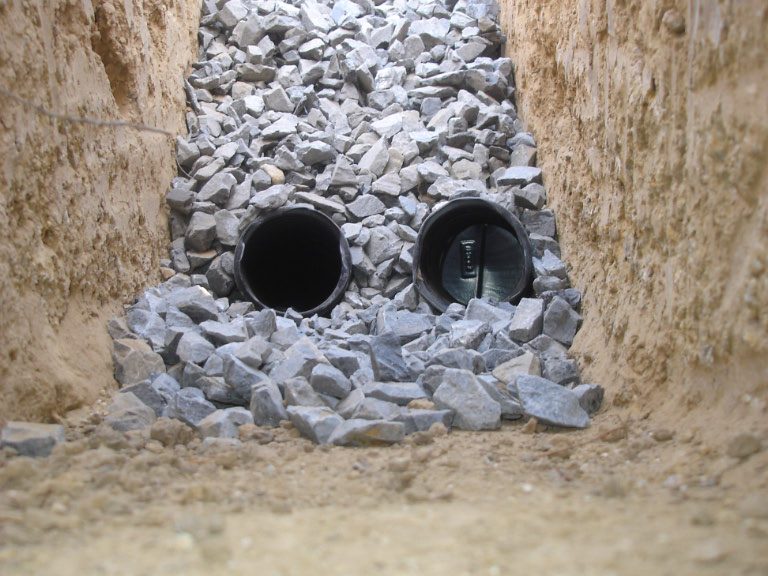
Catch Basins & Channel Drains for Pflugerville homes
Catch basins and channel drains collect surface water at a specific low point and send it into pipe. A catch basin is a box with a grate, set where water pools, such as the corner of a flat backyard. A channel drain is a long, narrow trench drain that spans a driveway apron, a patio edge or a walkway. In Pflugerville, where clay keeps water on the surface and many rear yards were graded nearly flat, these tools turn a soggy low spot into a managed collection point. The grate sits flush with the surface, so the lawn or concrete stays usable. Flat lots are where basins earn their keep, since there is no slope to guide the water on its own.
Where a channel drain works best is easy to spot. Garage aprons that slope toward the door, patios that tilt toward the house and walkways beside a wall all send water straight at a slab. A channel drain across the low edge catches that flow before it crosses the threshold. Catch basins fit better in open turf, where several small slopes meet. Both need a pipe outlet, typically 4 or 6 inch solid PVC buried with fall toward a curb, a storm inlet or a pop-up emitter. In flat Pflugerville subdivisions the outlet height often limits how deep the basin can sit. A basin also doubles as a junction. Downspout lines, channel drains and French drains can all tie into one box, which gives you a single point to inspect and clean.
Sizing matters in the Texas climate. A grate that handles a light rain will overflow in the kind of storm that drops several inches in an hour. Heavy-duty grates for driveways, bar spacing that does not snag a bike tire or a heel, and a sump that catches silt all help the system last. Clay silt clogs a basin fast, so a sump bucket or a deeper box lets you scoop out mud twice a year. Call 811 before digging, and check with your HOA before cutting a driveway or adding visible hardware near the street. Grate color and style can be matched to the concrete or the landscaping, and low-profile designs keep the yard looking tidy.
What to know in Pflugerville
Pick the grate for the load
A pedestrian-rated grate in a driveway will crack under a truck. Match the channel and grate class to what rolls over it. Plastic channels suit patios and walks, while heavier steel or cast-iron grates suit driveway aprons. The price difference is small compared with replacing a crushed run.
Depth limits on flat lots
A basin is only as useful as its outlet. On a flat Pflugerville lot, the pipe must fall to a lower exit, and that can restrict how deep the box sits. A site survey with a level shows whether gravity can do the job or if the water needs another route.
Plan for silt cleanout
Clay runoff carries fine silt that settles in the sump. Leave the grate removable and the box deep enough to hold sediment. Rinse the sump a couple of times a year, especially after construction nearby, so the pipe stays open for the next storm.
Signs you may need catch basins & channel drains
- A low spot in the lawn that holds water after every rain
- Water running across a patio or driveway toward a door or garage
- Puddles at the end of a swale or against a fence line
- Mud, sediment, or sand washing across hard surfaces
How catch basins & channel drains works
A catch basin is a box, usually plastic or concrete, set into the ground with an open grate on top. Water flows across the lawn, drops through the grate, and falls into the box. A pipe attached near the bottom carries it away. Many basins also have a sump, a few inches of empty space below the outlet pipe, where sand, leaves, and silt settle out instead of traveling down the line and clogging it. Catch basins are the right tool for a single low spot, such as the lowest corner of a back yard, where runoff gathers and has no natural way to leave. They are a point solution rather than a long-line one. Basins usually come in nine, twelve, and eighteen inch sizes, and the grate is chosen to match the amount of water headed its way.
A channel drain, sometimes called a trench drain, does the same job in a long, narrow strip. It is a shallow trough with a grate on top, set flush with the surface so water running across a patio, driveway apron, or garage threshold drops into it before it reaches the house. Channel drains come in widths from a few inches to ten or twelve inches, with plastic or metal grates built for foot traffic or, in heavier-duty versions, vehicle loads. Because they run in a line, they intercept sheet flow across a whole width, which a single basin cannot do. This makes them especially useful where a slab slopes toward a door. Slotted and bar grates differ in how much water they pass, so the grate type matters as much as the trough underneath it.
What to expect on a Pflugerville visit
- 01
Find the low spots and flow paths
We watch how water moves across your lot during or after rain, marking where it collects, where it crosses hard surfaces, and where it should leave. We also check the existing slope of patios and drives. This tells us whether a basin, a channel drain, or both are the right tools for your yard.
- 02
Size the system to the water
We estimate how much roof, paving, and lawn drains toward each point, then choose a grate size and pipe diameter that can handle it. Four-inch pipe works for many small yards, while larger areas call for six-inch. Sizing too small is the most common reason a drain overflows in a hard rain.
- 03
Call 811 and plan the outlet
Texas law requires a call to 811 at least two business days before digging, not counting weekends and holidays. We then confirm the outlet: a lower part of your lot, a pop-up emitter, a dry well, or an approved street connection. City and HOA rules differ, so we check before any trenching begins.
- 04
Excavate and set the basin or channel
The hole or trench is dug to the depth needed, and the base is leveled on compacted gravel so the unit does not settle. The grate is set slightly below the surrounding grade so water flows into it. Channel drains are set to a gentle slope, and they are anchored with concrete when they sit in a slab.
- 05
Connect solid pipe and add cleanouts
Solid pipe leaves the basin or channel and runs downhill to the outlet, joined with proper fittings and sealed at the connection. Cleanouts are added at turns so the line can be flushed. We run water into the system before backfill to check for leaks, standing water in the pipe, and the speed of flow.
- 06
Backfill, finish, and show you the upkeep
The trench is backfilled in layers, the surface is graded to feed water into the grate, and sod or concrete is restored. We then show you how to remove the grate, check the sump, and clear debris, so you know exactly what a simple spring and fall cleaning looks like. Ask to see it done once.
Our approach in Pflugerville
- We walk the property in Pflugerville and trace where water comes from, where it collects and where it can legally go
- We explain what we find in plain language, with photos where they help
- Repairs and installs are planned around Travis County permitting requirements
- You get written options before any repair work begins
- We call 811 to mark buried utilities before any digging
Soil and drainage conditions around Pflugerville
Water moves through Pflugerville along a handful of named creeks. Gilleland Creek begins northwest of town and runs about 27 miles to the Colorado River, and it was named for James Gilleland, an early settler. Wilbarger Creek rises north of town and drains east toward Bastrop County. Lake Pflugerville, the city's man-made lake, sits in the larger drainage network, and the city has built trails along the creek corridors. The terrain is gently rolling rather than steep, which sounds harmless until you remember that a few inches of fall across a whole subdivision sends sheet flow across many back yards before it reaches a ditch. Homes on the low side of a street, or backing onto a greenbelt or drainage easement, often receive the water that came off five or six lots uphill. Knowing which way your lot drains, and who is upstream, is the first real step in any fix. A fence line or raised bed can be enough to dam that sheet flow against a back wall.
Catch Basins & Channel Drains questions from Pflugerville homeowners
What is the difference between a catch basin and a channel drain?
A catch basin is a single box with a grate that collects water at one point. A channel drain is a long linear trench with a grate on top that collects water across a width, like a garage apron or patio. Both connect to pipe. The choice depends on the shape of your problem area. Many projects use both, linking the channel to a basin on the way to the outlet.
Can a channel drain be installed in an existing concrete driveway?
Yes. The concrete is saw cut, the old slab is removed in a narrow strip, and the channel is set in new concrete. It adds some cost and a curing time before you can drive on it. Check HOA and city rules first if the work reaches the street edge. Plan on a few days of cure time before vehicles use the repaired apron.
How often does a catch basin need cleaning?
Plan to check it after big storms and clear it at least a couple of times a year. In clay areas like Pflugerville, silt and leaves build up in the sump and can reach the pipe. Pulling the grate, scooping out debris and flushing the line with a hose takes only a few minutes. Fall leaf drop and construction dust from nearby building sites are the usual causes of a clogged box.
What is the difference between a catch basin and a channel drain?
A catch basin is a box with a grate that collects water at a single point, like the lowest corner of a yard. A channel drain is a long, narrow trough that catches water along a line, such as across a patio or driveway. Basins suit low spots, and channel drains suit water crossing a hard surface in a wide sheet. Many yards use one of each.
Where does the water from a catch basin go?
It travels through buried solid pipe to an outlet. Common outlets are a lower part of your own lot, a pop-up emitter, a dry well, or a street connection where your city allows it. Texas Water Code Section 11.086 prohibits diverting surface water in a way that damages a neighbor's property, so the outlet must be chosen with care. A site visit confirms the exit before work starts.
Will a channel drain stop water from entering my garage?
Often, yes, when the water runs across the driveway toward the door. A channel drain set across the slab intercepts the flow before it reaches the threshold. It must be sized for the volume of water and connected to a working outlet. If water seeps up through cracks, or the slab slopes strongly toward the door, additional fixes may be needed. A site visit shows which case applies.
More about catch basins & channel drains → · All services in Pflugerville →
Need catch basins & channel drains in Pflugerville?
Call or send a request. We will look at where the water goes, check the grade and give you a written estimate.